Disclosure: This page contains affiliate links. If you make a purchase through one of these links, we may earn a small commission at no extra cost to you.
If you’re visiting the Netherlands with kids, you’ll probably end up using public transport whether you planned to or not.
At first, that can feel a bit intimidating — especially if you’re used to driving everywhere in the US. But once you’re here, you’ll quickly notice something: if you’re mainly visiting Dutch cities, you probably won’t need a car. Public transport is often the easiest way to get around, especially if you’re staying in cities like Amsterdam, Rotterdam or Utrecht.
However, if you’re planning several day trips or want to explore the Dutch countryside, renting a car can be the more practical choice. While public transport reaches most destinations, some attractions are much quicker and easier to visit by car.
So the real question is not can you use it with kids, but more: is it actually practical, or does it become a hassle?
The honest answer is this: it’s easy most of the time, but not always comfortable.
What it actually feels like as a family
We’ve used trains, trams, and buses across the Netherlands with kids, and overall it works well. Cities are close together, trains run constantly, and you’re not stuck planning your entire day around transport.
That alone makes it a lot more relaxed than you might expect.
But let’s not pretend it’s perfect. You will walk more than you think. Platforms can be busy. And if you hit rush hour with kids, it can feel chaotic fast.
Still, compared to renting a car, figuring out parking, and navigating narrow streets, public transport is usually the better choice.
How Do You Know Which Train, Tram or Bus to Take?
If you’re visiting the Netherlands for the first time, figuring out which train, tram or bus to take may seem confusing. Fortunately, there are several apps that make planning your journey incredibly easy.
The app that most Dutch people use is 9292. Simply enter your starting point and destination, and the app will show you the fastest route, including trains, trams, buses and the metro. It even tells you which platform to use, where to transfer and how long the journey will take.
Another popular option is Google Maps, which also works very well for public transport in the Netherlands. In most cases, both apps provide accurate and up-to-date travel information.
If you’re traveling by train, the NS app is also worth downloading. It shows live departure times, delays and platform information, making it especially useful for longer journeys between cities.
In practice, using public transport in the Netherlands is much easier than many visitors expect. With one of these apps on your phone, you’ll rarely have trouble finding the right connection.
How the trains work (and why it’s easier than it sounds)
Most trains are run by Nederlandse Spoorwegen (NS), and they connect cities like Amsterdam, Rotterdam, Utrecht and The Hague.
The biggest difference compared to the US is this: you don’t need to reserve seats.
You just show up, check in, and take the next train.
And that’s honestly one of the best things about it. Trains run so often that missing one is not a problem. On busy routes, there’s usually another one within 10–15 minutes.
That flexibility makes traveling with kids much easier, because your day doesn’t fall apart if things don’t go exactly to plan.
Inside the train, it’s fine — not amazing, not terrible. There’s usually space for a stroller near the doors, and most trains have a toilet. But don’t expect a quiet, spacious experience, especially during busy times.
If you travel outside rush hour, it feels easy. During rush hour, it can feel like you made a bad decision.

Buying tickets (this part is actually very simple)
This is where most people overthink things. In reality, buying tickets in the Netherlands is surprisingly easy.
In most cases, you don’t need to buy a ticket at all. You can simply use your contactless debit card, credit card, Apple Pay or Google Pay to check in and out on trains, trams, buses and the metro. Just tap when you start your journey and tap again when you leave.
You may also see people using an OV-chipkaart, the Dutch public transport card that works on almost all public transport across the country. It’s available at larger train stations and service points, but if you’re only visiting for a few days, you probably won’t need one. Using your own bank card or phone is usually the easiest option.
In terms of cost, it’s not cheap, but it’s also not outrageous. A train from Amsterdam to Rotterdam is usually around €17–€20 per adult. A shorter trip, like Amsterdam to Utrecht, is closer to €10.
For kids, it’s actually quite good. Children under 4 travel for free. Kids aged 4 to 11 can use a Railrunner ticket, which costs around €2.50 for the entire day. That’s one of the few things in the Netherlands that feels like a real bargain.
If you don’t have a contactless bank card or an OV-chipkaart, you can usually buy tickets from ticket machines or transport apps. In Amsterdam, you can still buy a ticket on many trams, but this isn’t possible everywhere in the Netherlands, especially on buses. That’s why contactless payment is the easiest option for most visitors.
If you prefer having everything on your phone, the NS app works well and is easy to use in English.
The one thing that confuses everyone: checking in and out
This is the part that throws people off at first. Instead of showing a ticket, you check in and out using gates or card readers.
At larger stations, like in Amsterdam or Rotterdam, you tap your card at the gate to enter. When you arrive, you tap again to exit.
At smaller stations, there are no gates — just poles on the platform.
The system is simple, but it feels unfamiliar the first time. You’ll probably hesitate for a second, look around, and then copy what everyone else is doing.
The same system works on trains, buses, trams and the metro throughout the country, so once you’ve done it once, you’ll know exactly what to do everywhere else.
One important thing: always use the same card or phone when checking in and out. If you don’t, you’ll end up paying more than you should.
Getting around within cities
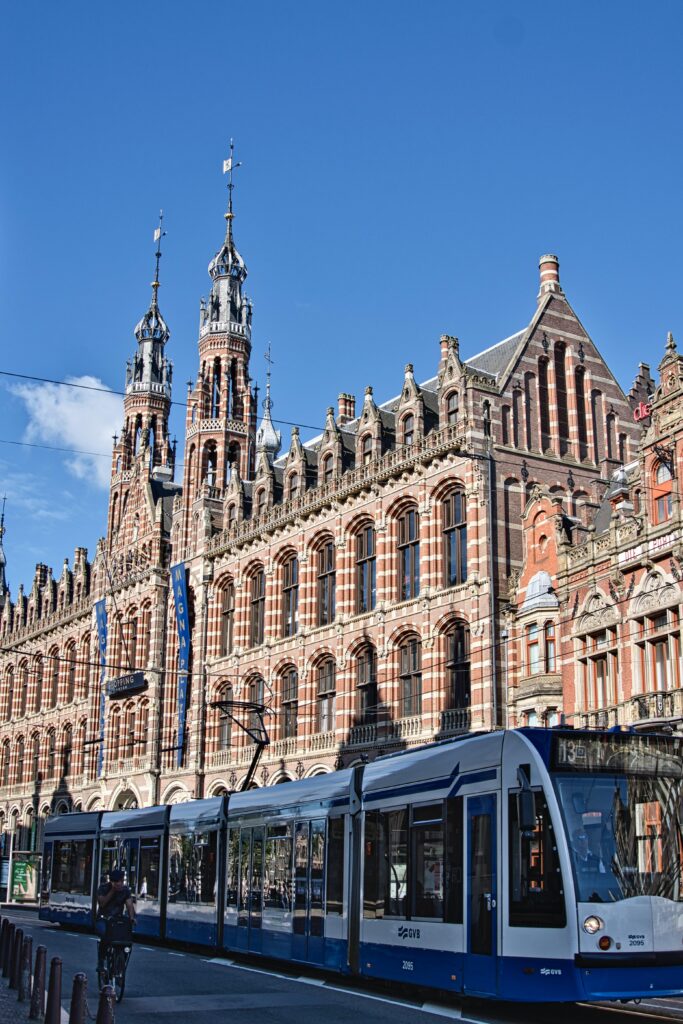
Once you’re in a city, you’ll switch to trams, buses, or the metro. And the good news is: it works exactly the same way. Tap in, tap out.
In Amsterdam, you’ll probably use trams the most. In Rotterdam, the metro is often more useful.
Prices are usually just a few euros per ride, depending on distance.
It’s simple — but not always relaxing. Trams can be crowded, people move quickly, and you’re often juggling kids, bags, and trying not to miss your stop.
Traveling with a stroller: doable, but not ideal
Yes, you can do it. But it’s not as smooth as some blogs make it sound.
There are elevators in most larger stations, but they’re not always where you need them. Sometimes you’ll walk quite a bit just to get to the right platform.
On trains, there’s space for strollers, but it’s limited. If it’s busy, you’ll feel in the way.
Same with trams — technically accessible, but not always comfortable.
If you’re traveling with a stroller, a compact one makes a huge difference. Big strollers are possible, but you’ll notice the extra effort every time you move.
When renting a car actually makes more sense
While public transport works extremely well for visiting Dutch cities, there are situations where renting a car simply makes life easier.
Some of the Netherlands’ best family attractions are outside the major cities. Places such as the Veluwe National Park, the Three-Country Point, parts of Limburg and smaller villages are all accessible by public transport, but getting there often involves multiple trains, buses or longer walking distances. What may take an hour by car can easily turn into a journey of two hours or more by public transport.
If your itinerary mainly includes Amsterdam, Rotterdam, Utrecht and The Hague, we would happily recommend using trains and local public transport throughout your trip.
However, if you’re planning to explore several regions, travel with young children or visit attractions in the countryside, renting a car can save a significant amount of time and make your holiday much more flexible. It allows you to travel at your own pace, carry everything you need for the kids and reach destinations that are less convenient by public transport.
Many families actually choose a combination of both: they use public transport while staying in the larger cities and rent a car for the countryside or the second half of their trip. In our experience, that’s often the best of both worlds.
Planning to rent a car? We recommend comparing prices in advance at DiscoverCars, especially during the busy spring and summer months, as rental prices can vary considerably.

Is public transport in the Netherlands safe with kids?
In general, yes — public transport in the Netherlands is very safe.
Trains, stations, and city transport are well maintained, and it’s completely normal to travel with kids at any time of day. You’ll see families everywhere, not just tourists but also locals going about their daily routines.
We’ve personally never felt unsafe using trains or public transport with kids, even in bigger cities like Amsterdam or Rotterdam.
That said, it’s not completely risk-free — and it’s better to be realistic about that.
Late at night, especially at smaller or quieter stations, the atmosphere can feel a bit uncomfortable. Not dangerous in most cases, but simply empty and less pleasant. If you’re traveling with kids, it’s usually better to avoid those situations when you can.
During the day and early evening, though, it’s absolutely fine.
Like anywhere else, basic awareness goes a long way. Keep an eye on your belongings, stay in well-lit areas, and you’ll likely have no issues at all.
So, is public transport in the Netherlands easy with kids?
We would definitely recommend it. It may feel a little confusing at first, especially if you’ve never used a public transport system like this before. But after your first journey, you’ll quickly get the hang of it.
For many families visiting the Netherlands, taking the train and local public transport is the easiest option—especially if your trip focuses on cities like Amsterdam, Rotterdam, Utrecht and The Hague. However, if you’re planning to explore the countryside or several different regions, renting a car for part of your trip can save a lot of time and offer much more flexibility.
Are you looking for inspiration for where to go during your holiday in the Netherlands? Have a look at our Ultimate Netherlands Itinerary with Kids!
Frequently Asked Questions (FAQ) about public transport in the Netherlands
Yes. Most tourists can simply use a contactless debit card, credit card, Apple Pay or Google Pay to check in and out on trains, trams, buses and the metro. There’s usually no need to buy an OV-chipkaart.
Yes. Most public transport in the Netherlands accepts contactless payment with debit cards, credit cards, Apple Pay and Google Pay. Just use the same card or phone to check in and check out.
Children under 4 travel free on Dutch trains. Children aged 4 to 11 can travel all day with a Railrunner ticket, making train travel very affordable for families.
Yes, you can usually buy a ticket on Amsterdam trams using a debit or credit card. However, this isn’t the case everywhere in the Netherlands, so contactless payment or an OV-chipkaart is often the easiest option.
Most trains, metros and trams are accessible with a stroller, but a compact stroller is much easier to use. Larger stations have elevators, although you may have to walk a bit to reach them.